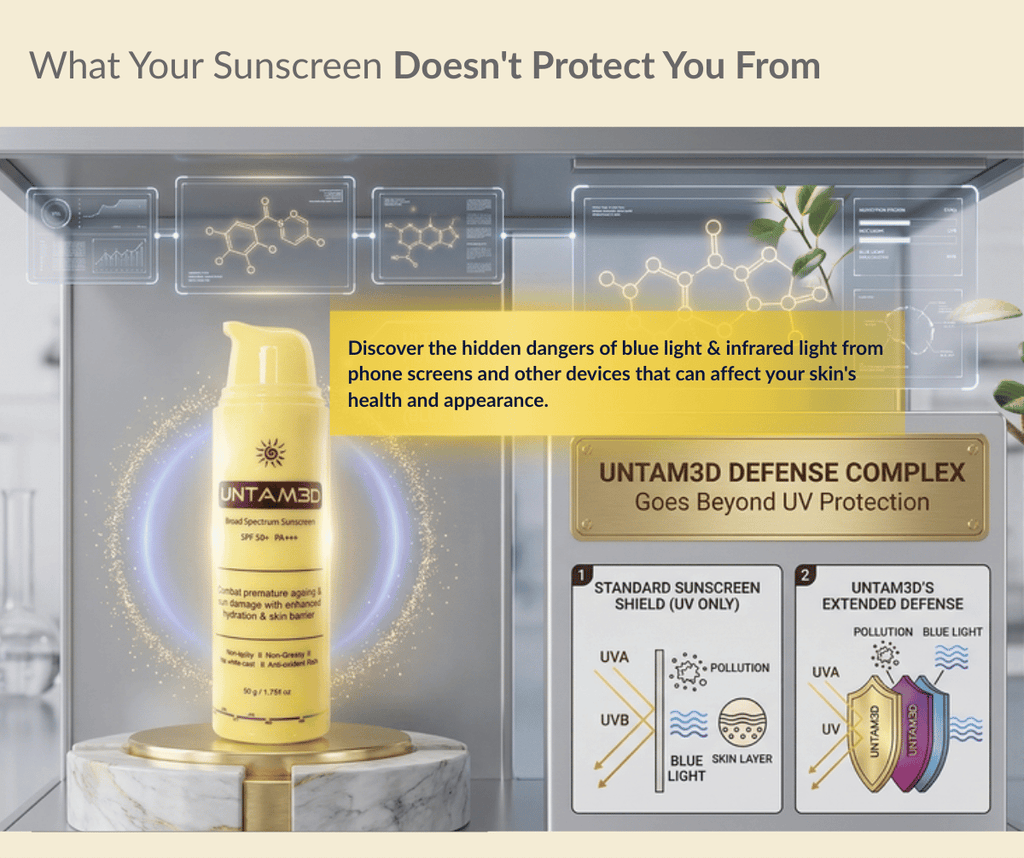
What Your Sunscreen Doesn't Protect You From
What Your Sunscreen Doesn't Protect You From (And What UNTAM3D Does)
The truth: Traditional sunscreen—even broad-spectrum SPF 50+ PA+++—protects against UVA and UVB radiation but misses two other forms of radiation that damage skin: blue light (visible light radiation) and infrared radiation (heat). For Indian women who spend 8+ hours daily in front of screens and work in intensely heated environments, these invisible forms of radiation cause oxidative stress, collagen breakdown, and accelerated aging that sunscreen alone can't prevent. True broad-spectrum protection in 2026 requires formulations that address four radiation types: UVA, UVB, blue light, and infrared. UNTAM3D's approach recognizes this reality and builds protection against all four into a single daily serum-sunscreen combination, replacing the myth that SPF number tells the complete protection story.
For decades, "broad-spectrum" sunscreen meant UVA and UVB protection. That definition has become dangerously outdated. Modern research reveals that blue light and infrared radiation inflict skin damage comparable to UV rays, yet standard sunscreen doesn't address them. For Indian women balancing intense outdoor sun exposure with screen time in air-conditioned offices, traditional sunscreen is like using half a lock on your front door. This guide explains what standard sunscreen misses and why complete protection requires rethinking your entire approach to sun and radiation defense.
What Exactly is Blue Light, and Why Does It Damage Skin?
Blue light is part of the visible light spectrum—the light you see when looking at screens, indoor lighting, and especially the sun. Unlike UV radiation, which is invisible, blue light is visible as the blue-ish hue of digital screens and the daytime sky. But visibility doesn't mean harmlessness. Blue light penetrates into the upper dermis, reaching collagen-producing cells.
Blue light damages skin through a specific mechanism: it generates reactive oxygen species (ROS), also called free radicals, in skin cells. These free radicals attack collagen, break down cellular structures, and accelerate aging. The damage accumulates over time. Someone spending 8 hours daily in front of computer and phone screens receives chronic blue light exposure that, while not as acutely damaging as sunburning UV rays, produces measurable skin aging over years. Emerging research suggests that prolonged blue light exposure may contribute to oxidative stress in skin cells, though the magnitude of this effect compared to UV exposure is still being studied. What is established is that blue light generates reactive oxygen species in skin, which over years of cumulative exposure can contribute to visible aging.
In India, where air-conditioned offices with intense indoor lighting are standard and screen usage is pervasive, blue light exposure is constant and often unacknowledged. You're not sunburning from blue light—there's no immediate visible damage like redness or peeling. The aging happens invisibly, at a cellular level, through cumulative free radical damage that becomes apparent 10-15 years later as premature lines, sagging, and pigmentation changes you can't explain.
Infrared Radiation: The Heat Damage Happening Right Now
Infrared radiation is heat—the warmth you feel from the sun, from heating systems, and from your environment. Unlike UV rays, which carry enough energy to directly damage DNA and collagen, infrared radiation works through heat. It increases skin temperature, which triggers inflammatory responses, accelerates collagen breakdown through increased metalloproteinase activity, and exacerbates oxidative stress. In India's tropical climate, where outdoor temperatures regularly exceed 35°C and humidity intensifies heat perception, infrared radiation exposure is extreme.
The mechanism is subtle but relentless. Heat increases skin temperature, which activates heat shock response proteins. This adaptive response becomes problematic with chronic exposure—constant heat-triggered activation exhausts protective systems and accelerates aging at a cellular level. Additionally, heat increases transepidermal water loss (TEWL), compromising the skin barrier and making skin more vulnerable to irritants and reactive damage. People living in hot climates often have compromised barriers not from harsh products but from environmental heat exposure.
Heat also exacerbates existing skin conditions. Melasma, hyperpigmentation, and inflammatory skin conditions worsen with heat exposure. The combination of UV radiation plus heat plus humidity creates a perfect storm for accelerated aging and pigmentation issues in Indian climates. Standard sunscreen provides some surface protection but doesn't specifically target the underlying heat-triggered oxidative stress pathways. This is where antioxidant-rich skincare can play a complementary role.
Why Standard Sunscreen Can't Protect Against All Four Radiation Types
Traditional sunscreen uses UV filters—either physical (mineral) or chemical compounds that absorb or reflect UVA and UVB rays. These filters are ineffective against blue light and infrared radiation because those radiation types work through different mechanisms. Blue light requires antioxidant protection to neutralize the free radicals it generates. Infrared radiation requires systemic anti-inflammatory support and cellular adaptation mechanisms, not barrier-based blocking.
This is why adding zinc oxide to sunscreen (a common strategy) doesn't meaningfully increase blue light protection. Zinc oxide is excellent for reflecting UV rays but doesn't neutralize blue light free radicals. Similarly, applying more sunscreen doesn't address infrared heat damage—the heat still penetrates skin and activates the inflammatory cascade regardless of sunscreen presence. True protection against all four radiation types requires a different formulation approach entirely: combining UV filters with blue light-neutralizing antioxidants and infrared-protective ingredients that support cellular resilience against heat damage.
This is also why UNTAM3D's approach differs from standard sunscreen marketing. Rather than claiming sunscreen alone solves protection, UNTAM3D acknowledges that complete radiation protection requires formulations addressing the four types of radiation simultaneously. A sunscreen without blue light protection is incomplete. A sunscreen without infrared protective mechanisms leaves heat damage unaddressed. Marketing the SPF number while ignoring blue light and infrared creates false security—you're protected against two radiation types while three others accumulate damage invisibly.
The Blue Light Protection Paradox: Screens Intensify Damage
This is counterintuitive for many people: screens expose you to blue light, but reducing screen time isn't a realistic solution. Instead, understanding how to protect yourself against consistent screen exposure is essential for modern skin health. The intensity of blue light from screens is lower than from sunlight, but the duration of exposure and proximity matter enormously. Someone spending 2 hours in the sun receives intense but brief blue light exposure. Someone spending 8 hours at a desk receives prolonged, lower-intensity exposure at close range. The cumulative effect is comparable to outdoor exposure, spread across the entire workday.
The paradox deepens when you consider the modern habit of screen time increasing annually. Ten years ago, average daily screen time in India's urban centers was 3-4 hours. In 2026, it's 8-12 hours for most professionals. This means blue light exposure from screens is now comparable to or exceeding blue light exposure from outdoor sun time for many Indians. Yet sunscreen protocols focus entirely on outdoor sun protection—when you leave the office. The 8 hours spent indoors accumulating blue light damage are unaddressed.
This creates a hidden aging accelerant. Someone diligent about SPF 50+ PA+++ sunscreen for outdoor time but unprotected against blue light indoors is still experiencing significant cumulative damage. The photoaging isn't coming entirely from the 30 minutes of morning sun exposure—it's coming from the 8 hours of screen time, the 4 hours of indoor lighting, and the outdoor sun simultaneously. Without blue light protection as part of your daily skincare routine, you're only addressing perhaps 25% of your daily radiation exposure.
How Infrared Damage Compounds in India's Heat
India's climate presents a uniquely challenging environment for skin aging. The combination of intense solar radiation (UVA, UVB, blue light, and infrared simultaneously) plus high ambient temperatures creates layered damage. Someone in a temperate climate with 20°C temperatures and moderate sun exposure experiences less infrared stress than someone in Delhi or Mumbai with 35°C+ temperatures and intense solar radiation. The heat load on skin is exponentially higher, accelerating every aging mechanism.
Add to this the reality of Indian work environments: air conditioning creates extreme temperature differentials. You're in 35°C outdoor heat, then walk into a 22°C office, then back outside. These repeated thermal shocks trigger inflammatory responses, compromise barrier function, and stress skin cells. The combination of outdoor infrared exposure plus repeated thermal cycling creates perfect conditions for accelerated collagen breakdown and barrier compromise. Standard sunscreen, which doesn't address heat-triggered damage mechanisms, leaves this damage unchecked.
This is why dermatologists in India increasingly recognize that sun protection must include support for heat-triggered damage. Antioxidants that neutralize ROS (reactive oxygen species) generated by both blue light and infrared become essential year-round, not optional anti-aging luxury. For Indian skin, the foundation isn't just SPF 50+ PA+++—it's SPF 50+ PA+++ plus comprehensive antioxidant support addressing all radiation types simultaneously.
The Science Behind Antioxidant Protection Against Blue Light and Heat
Antioxidants work by neutralizing free radicals—those reactive oxygen species generated by blue light and infrared radiation. The most evidence-backed antioxidants for skin are vitamins C and E, polyphenols (including green tea EGCG), and plant compounds with proven ROS-scavenging capacity. When applied topically, these antioxidants intercept free radicals before they damage collagen, elastin, and cellular DNA. They don't prevent blue light from reaching skin (no topical product can), but they neutralize the damaging effects of that light.
EGCG (green tea extract) is particularly relevant for blue light protection. Studies show EGCG-containing products reduce blue light-induced ROS generation and prevent the resulting collagen breakdown. When combined with retinol (which stimulates collagen production and repair), EGCG addresses both blue light damage prevention and active collagen regeneration. For infrared protection, antioxidants work similarly—they neutralize heat-triggered free radical cascades before those radicals damage structural proteins.
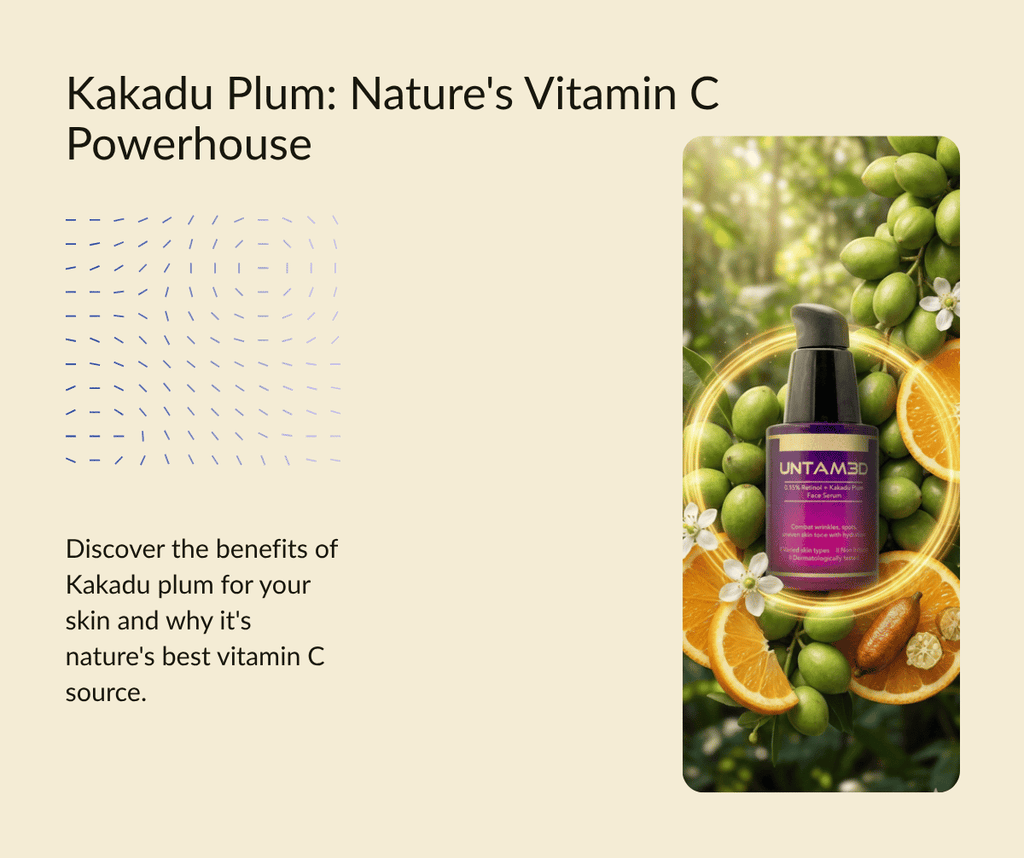
Kakadu Plum, with its exceptional vitamin C concentration, provides multiple mechanisms of protection: direct free radical neutralization, collagen synthesis support, and melanin regulation (addressing the hyperpigmentation that heat and UV combined often trigger). The combination of comprehensive antioxidant protection with active ingredients supporting cellular repair creates a complete defense system against all four radiation types—something no sunscreen alone can achieve.
Why "Broad Spectrum" Marketing Became Misleading
When "broad spectrum" entered sunscreen marketing 15+ years ago, it meant protection against UVA and UVB—the two types of solar radiation known to damage skin at that time. Over the past decade, scientific understanding expanded: blue light and infrared are now recognized as significant skin aging factors. Yet marketing hasn't caught up. Products still claim "broad-spectrum protection" while ignoring blue light and infrared entirely. The term has become outdated and misleading.
True broad-spectrum protection in 2026 requires addressing four radiation types: UVA, UVB, blue light, and infrared. Calling a product "broad-spectrum" while it only addresses two of these four is technically accurate but fundamentally misleading to consumers who reasonably assume "broad-spectrum" means comprehensive radiation protection. This marketing gap is where misinformation thrives. People trust that their "broad-spectrum sunscreen" is protecting them comprehensively, when in reality they're leaving blue light and infrared damage unaddressed.
This is why UNTAM3D takes a different approach: acknowledging that sunscreen isn't enough. Sunscreen handles UVA and UVB—critical protection, absolutely non-negotiable. But for complete radiation defense, you need additional protection against blue light and infrared. This doesn't mean replacing sunscreen—it means complementing SPF 50+ PA+++ with formulations containing antioxidants, retinol, and heat-protective ingredients that address the full spectrum of radiation threats.
UNTAM3D's Comprehensive Radiation Protection Approach
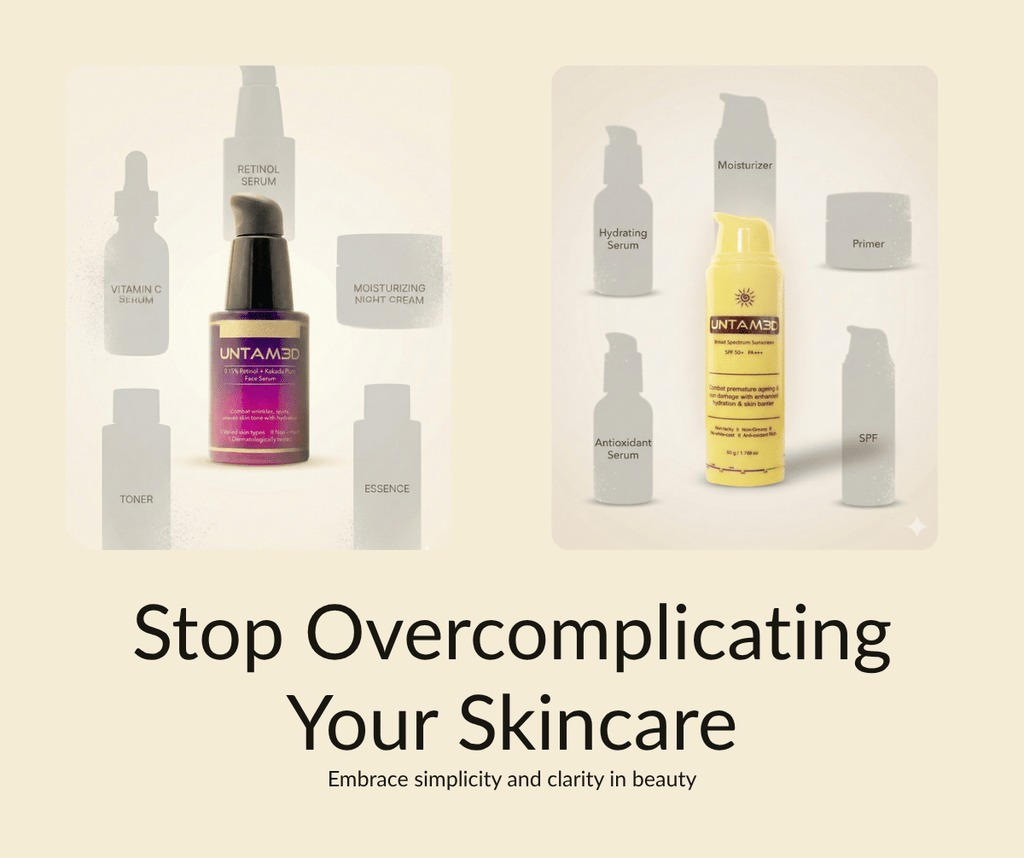
UNTAM3D's product philosophy recognizes that complete protection requires addressing all four radiation types. The Broad Spectrum Sunscreen SPF 50+ PA+++ provides essential UV protection (UVA and UVB). Its formulation includes antioxidant-supporting ingredients that help neutralize free radicals generated by visible light exposure. Combined with comprehensive UV filtration, this represents a more holistic approach to daily protection.
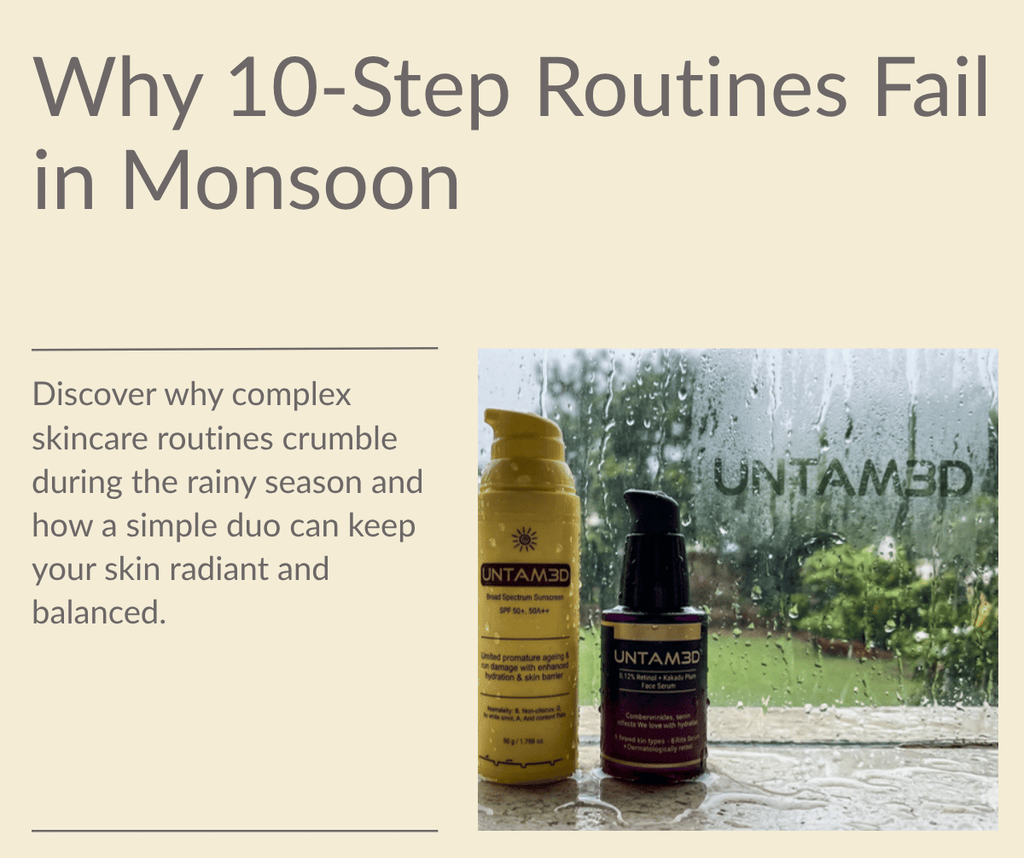
The Retinol + Kakadu Plum Face Serum provides the antioxidant fortress that completes comprehensive radiation protection. EGCG and Kakadu Plum neutralize free radicals generated by blue light (whether from screens, indoor lighting, or sunlight) and infrared radiation (whether from outdoor heat or environmental temperature stress). Retinol stimulates collagen production and repair, counteracting the collagen breakdown that both blue light and infrared trigger. Used together, the sunscreen and serum create layered, complete protection against all four radiation types.
This two-step approach replaces the myth that sunscreen alone solves protection. Instead, it acknowledges that modern skin faces complex, layered radiation threats requiring complex protection. Blue light from screens requires sustained antioxidant defense. Infrared from heat requires collagen support and cellular resilience. UV radiation requires sunscreen. None of these can be fully addressed by a single product—yet combining formulations engineered specifically for each threat delivers comprehensive protection far exceeding what traditional sunscreen alone can provide.
For Indian skin especially, where blue light exposure (screens) is constant, heat exposure is extreme, and outdoor sun exposure is intense, this layered approach is essential. It's not luxury skincare—it's the minimum effective protection against the radiation environment Indian women actually inhabit.
Shop Complete Radiation ProtectionFrequently Asked Questions About Blue Light and Infrared Protection
Does blue light from screens really cause visible aging, or is it just marketing hype?
Blue light from screens does cause measurable skin damage through free radical generation. Multiple peer-reviewed dermatological studies document blue light-induced ROS generation, collagen breakdown, and visible aging effects including fine lines and pigmentation changes. The damage is slower and less obvious than UV sunburning, which is why it's easy to dismiss as marketing hype. But 8+ hours daily of unprotected blue light exposure over 10 years produces significant cumulative aging—absolutely not hype, just subtle and delayed compared to acute sun damage.
Can you see blue light damage on your skin, or is it always invisible?
Blue light damage accumulates invisibly for years before becoming visible as premature aging. The first visible signs typically appear after 5-10 years of consistent unprotected exposure: fine lines, loss of firmness, uneven skin tone, and sometimes hyperpigmentation. By the time you notice blue light damage, significant collagen breakdown has already occurred—which is why prevention through daily antioxidant protection is far more effective than trying to reverse the damage later.
Are blue light blocking glasses or phone filters sufficient protection against screen blue light?
Blue light blocking glasses and screen filters reduce blue light reaching your eyes, which helps prevent digital eye strain and sleep disruption. However, they don't prevent blue light from reaching your skin. Your face is exposed to screen blue light regardless of whether your eyes have protection. Skin protection against blue light requires topical antioxidants applied daily—skincare rather than eyewear.
Is infrared radiation only a problem outdoors, or does indoor heat matter too?
Infrared radiation from outdoor sun is more intense, but indoor heat still triggers damage mechanisms. Sitting in a warm room, near heating systems, or in the sun shining through windows generates infrared heat exposure that activates inflammatory responses and accelerates aging. The cumulative effect of daily indoor heat exposure, especially in hot climates, is significant. This is why heat-protective ingredients and antioxidants should be part of your year-round skincare, not just summer skincare.
Can one antioxidant serum protect against both blue light and infrared, or do you need separate products?
A single well-formulated serum containing multiple antioxidants (like EGCG, vitamin C from Kakadu Plum, and vitamin E) can provide meaningful protection against both blue light and infrared damage. The key is concentration and stability of antioxidants. A lightweight antioxidant serum containing retinol, EGCG, and Kakadu Plum provides robust protection without requiring multiple products. Simpler is better if the formulation is comprehensive.
Should you apply antioxidant serums before or after sunscreen?
Apply antioxidant serums before sunscreen. The serum absorbs into skin, providing internal cellular protection against blue light and infrared. Sunscreen sits on the surface, protecting against UV rays. Applied in sequence, they work through different mechanisms on different skin layers. Allow the serum to fully absorb (2-3 minutes) before applying sunscreen to avoid disrupting the sunscreen's protective barrier formation.
Rethinking Sun Protection for the Modern World
For decades, sun protection meant one thing: SPF. Higher numbers, better protection. This framework worked when UV rays were the primary understood threat. But in 2026, we know better. Your skin faces layered radiation threats simultaneously: UVA, UVB, blue light from screens and indoor lighting, and infrared heat from environmental temperature. Standard sunscreen addresses two of these four threats. The other two accumulate damage invisibly until suddenly, years later, you're dealing with premature aging that seems unexplainable.
Modern sun protection requires acknowledging this complexity and building a layered defense system. Sunscreen for UV protection remains essential—non-negotiable, actually. But it's not sufficient. Complementary antioxidant formulations that address blue light and infrared become equally essential. This isn't about adding more steps or complexity—it's about ensuring the steps you take address the actual threats you face. A single effective retinol and antioxidant serum combined with a single effective broad-spectrum sunscreen provides superior protection to three different sunscreens that ignore blue light and infrared entirely.
For Indian women balancing intense sun exposure, constant screen time, and extreme heat, this comprehensive approach isn't luxury skincare—it's the baseline minimum for maintaining skin health. Sunscreen-only protection leaves other forms of radiation damage unaddressed. Complete protection requires acknowledging all four radiation types and building formulations that defend against each one.
Sources and Further Reading
- Journal of the American Academy of Dermatology: Blue Light Effects on Skin and Collagen
- Photodermatology, Photoimmunology & Photomedicine: Infrared Radiation and Heat-Induced Aging
- Free Radical Biology and Medicine: Blue Light-Induced ROS Generation in Skin
- Journal of Cosmetic Dermatology: EGCG Protection Against Blue Light Damage
- International Journal of Dermatology: Cumulative Effects of Screen Blue Light Exposure
- Antioxidants: Polyphenol Protection Against Visible Light Damage
- Journal of Environmental and Public Health: Heat Stress and Skin Aging
RECENT POSTS