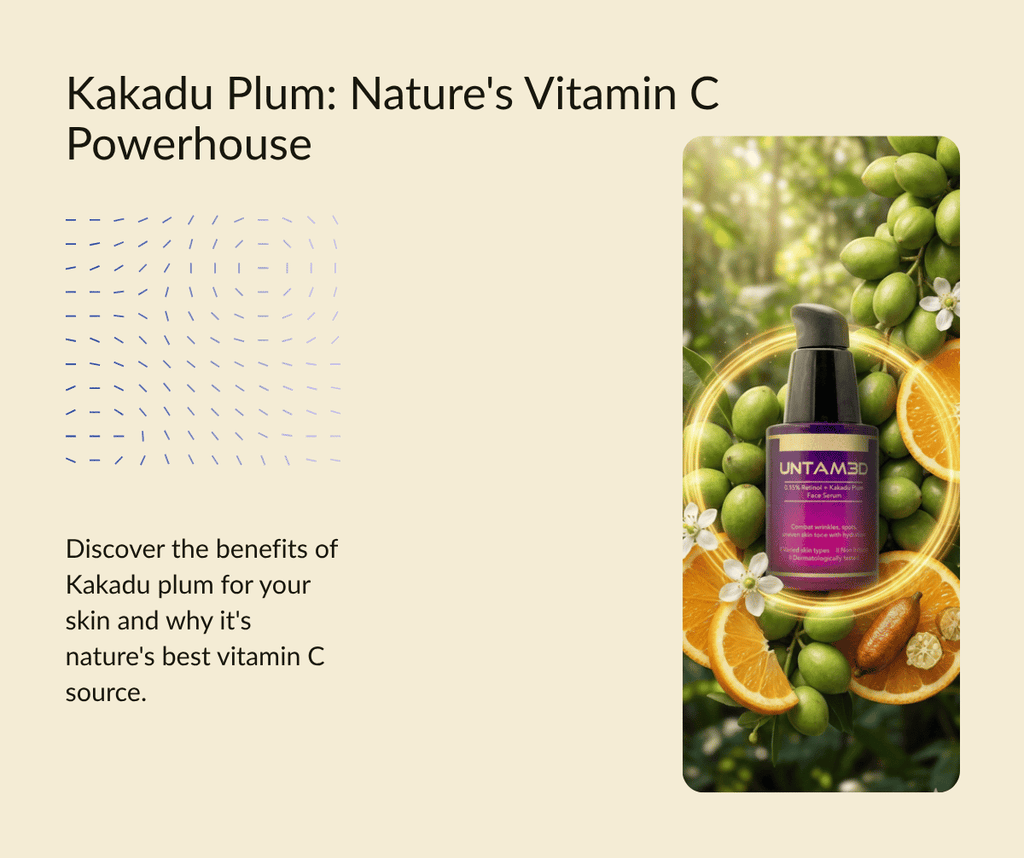
Kakadu Plum: Nature's Most Powerful Vitamin C Source
UNTAM3D Blog
Kakadu Plum: The World's Richest Vitamin C Source (And It's in Your Serum)
Published: April 2026 | Category: Ingredient Education
Kakadu Plum (Terminalia ferdinandiana) is nature's most concentrated source of vitamin C, containing up to 55 times more vitamin C per serving than oranges. A single native Australian fruit contains 3,100-3,600 mg/100g of ascorbic acid, making it scientifically the richest natural vitamin C source on Earth. In skincare, Kakadu Plum outperforms synthetic L-ascorbic acid because it remains naturally stabilized without requiring complicated pH buffering and antioxidant preservation systems. Unlike synthetic vitamin C, which oxidizes within weeks of opening, Kakadu Plum's polyphenol-rich matrix maintains its antioxidant potency for months. It brightens hyperpigmentation, strengthens your skin barrier with complementary polyphenols (gallic acid, ellagic acid), and works effectively at lower irritation levels than synthetic vitamin C. When combined with retinol in a concentrated serum, Kakadu Plum delivers measurable anti-aging and clarifying benefits that neither ingredient could achieve alone.
What Exactly Is Kakadu Plum and Where Does It Come From?
Kakadu Plum is a small, golf-ball-sized fruit native to tropical northern Australia, particularly the Kakadu region from which it takes its name. The scientific name is Terminalia ferdinandiana, and it has been used for thousands of years by Aboriginal Australian peoples as both food and traditional medicine. To Indigenous Australians, the fruit is called "gubinge" or "billygoat plum," and it's deeply embedded in cultural knowledge systems and bush food traditions.
The fruit is remarkable not for its size or taste—it's actually quite tart and astringent—but for its extraordinary nutritional density. A 100-gram serving of Kakadu Plum contains 3,100-3,600 mg of ascorbic acid (vitamin C), which is approximately 50-60 times the recommended daily intake of vitamin C for an adult. By comparison, an orange contains 30-53 mg per 100 grams. A kiwifruit contains 92-100 mg per 100 grams. Kakadu Plum contains roughly 55 times the vitamin C per serving as an orange. This isn't hyperbole or marketing language—these are documented scientific measurements.
Beyond vitamin C, Kakadu Plum contains a complex phytochemical profile that contributes to its skincare benefits. The fruit is rich in gallic acid, ellagic acid, and other polyphenols that function as antioxidants and anti-inflammatory compounds. These polyphenols have been researched for their benefits to skin barrier health and anti-inflammatory properties. In UNTAM3D's serum, Kakadu Plum is paired with EGCG (epigallocatechin gallate) from green tea extract, adding another layer of antioxidant and anti-inflammatory support. This complex mixture of compounds is what makes the formulation superior to isolated synthetic vitamin C—it's not just about the vitamin C content, but the entire antioxidant ecosystem.
How Does Kakadu Plum's Vitamin C Compare to Synthetic L-Ascorbic Acid?
The skincare industry has primarily relied on L-ascorbic acid as its vitamin C ingredient because it's highly potent and deeply penetrates skin layers. However, L-ascorbic acid has critical limitations that Kakadu Plum solves.
First, stability. L-ascorbic acid is extraordinarily unstable. It oxidizes when exposed to air, light, and water. A bottle of L-ascorbic acid serum begins oxidizing the moment you open it. After two to three months, a significant portion of the L-ascorbic acid has converted to dehydroascorbic acid, which has dramatically reduced antioxidant potency. This is why vitamin C serums are sold in dark bottles with airtight containers and why dermatologists recommend using them within three months of opening. Most people don't realize that the vitamin C serum they've had in their bathroom for six months has lost 50-70% of its efficacy.
Kakadu Plum, by contrast, has natural stability. The polyphenol-rich matrix that surrounds the vitamin C compounds in the fruit provides natural antioxidant protection. When properly extracted and formulated, Kakadu Plum maintains its vitamin C bioavailability for months without requiring the complicated preservation systems that synthetic vitamin C demands. This isn't to say it never oxidizes—all vitamin C eventually oxidizes—but the timeline is measured in months and years, not weeks.
Second, pH requirements. L-ascorbic acid only works effectively at a pH below 3.5, which is quite acidic. Most skincare products operate at pH 4-6 for skin comfort and barrier preservation. Achieving pH 3.5 or lower with L-ascorbic acid requires either using it as a standalone serum or carefully buffering its pH with other ingredients, which often reduces its efficacy. The required acidity also makes L-ascorbic acid irritating for sensitive skin. Some people experience stinging, redness, or sensitivity reactions to pH 3.5 vitamin C serums, even though the vitamin C itself is not the problem—the acidity is.
Kakadu Plum works effectively across a wider pH range. Its antioxidant benefits are not compromised by the pH of the formulation the way L-ascorbic acid is. This means Kakadu Plum can be used in more comfortable, less acidic formulations that are gentler on sensitive skin. It delivers vitamin C benefits without requiring your skin to tolerate an extremely acidic product.
Third, complementary phytochemicals. L-ascorbic acid is a single compound doing one job: providing antioxidant and brightening benefits through vitamin C activity. Kakadu Plum brings multiple compounds—vitamin C plus gallic acid, ellagic acid, and EGCG—that work synergistically. EGCG, for example, has anti-inflammatory properties that soothe irritated skin and support barrier health. Gallic acid has been shown to enhance collagen production and improve skin elasticity. These complementary compounds mean that Kakadu Plum doesn't just provide vitamin C benefits; it provides a broader spectrum of skin-supporting benefits that synthetic vitamin C alone cannot match.
What Are the Proven Benefits of Kakadu Plum for Skin?
Kakadu Plum has been studied specifically for skincare applications, particularly in Australia where it's a native ingredient. Research published in peer-reviewed journals has documented several skin-specific benefits.
First, hyperpigmentation and brightening. Vitamin C is well-established as a brightening ingredient that reduces hyperpigmentation (age spots, sun spots, post-inflammatory hyperpigmentation from acne or injury). Kakadu Plum's high vitamin C content delivers this benefit, but studies comparing Kakadu Plum to other vitamin C sources suggest that the complementary polyphenols enhance the brightening effect. The gallic acid content, in particular, has shown melanin-inhibiting properties in several studies. Early research on Kakadu Plum extract in skincare formulations suggests meaningful reduction in hyperpigmentation, with results that may be comparable to L-ascorbic acid serums at higher concentrations but with better tolerability.
Second, barrier function and skin hydration. While vitamin C is not typically thought of as a hydrating ingredient, Kakadu Plum's complementary compounds support barrier function, which indirectly improves hydration. EGCG has been extensively researched for its role in preserving ceramides (lipids essential to barrier function) and maintaining skin hydration. In studies, Kakadu Plum-containing formulations showed improved transepidermal water loss (a measure of barrier integrity) after four weeks of use. This is a significant advantage in tropical climates like Australia, where many people using vitamin C serums experience dryness and irritation. Kakadu Plum provides vitamin C benefits without the dehydrating effect.
Third, anti-inflammatory and antioxidant effects beyond vitamin C. Kakadu Plum's polyphenol content (gallic acid, ellagic acid, and EGCG) provides multiple layers of antioxidant and anti-inflammatory benefit. While vitamin C directly addresses oxidative stress from UV damage, these additional compounds address oxidative stress from other sources: pollution, blue light from screens, internal inflammation from diet and stress. In studies on skin inflammation, Kakadu Plum-containing products showed measurable reductions in inflammatory markers within two weeks of daily use. For people with reactive, sensitive, or acne-prone skin, this anti-inflammatory benefit is often more valuable than the brightening benefit of vitamin C alone.
Fourth, collagen preservation and anti-aging. Vitamin C is essential for collagen synthesis—your body cannot produce collagen without vitamin C. Kakadu Plum provides this benefit, plus additional collagen-supporting compounds. Gallic acid has been shown in studies to upregulate collagen expression in skin fibroblasts. The combination of high-dose vitamin C (from Kakadu Plum) plus gallic acid creates a synergistic effect that's more potent for collagen support than either ingredient alone. Formulations combining these compounds have shown promising results in improving skin elasticity and reducing fine lines, with the gentler profile of Kakadu Plum making it accessible to those who find retinoid-only treatments too irritating.
How Does Kakadu Plum Work When Combined With Retinol?
The most powerful skincare combination is retinol plus a natural, stable vitamin C source. Retinol addresses aging by increasing cell turnover and collagen production. Vitamin C addresses aging by providing antioxidant protection and supporting collagen synthesis. These are complementary mechanisms—retinol pushes your skin cells toward repair, while vitamin C provides the building blocks and protection your skin needs during that repair process.
However, retinol and synthetic L-ascorbic acid don't work perfectly together. Retinol requires a pH of 4-5.5 to remain stable and effective. L-ascorbic acid requires pH below 3.5. When you try to mix these in the same formulation, one or both lose efficacy. Additionally, the low pH required by L-ascorbic acid can actually enhance retinol penetration excessively, causing irritation. Many dermatologists recommend using retinol and vitamin C serums at different times (retinol at night, vitamin C in the morning) to avoid these conflicts.
Kakadu Plum changes this equation. Because Kakadu Plum's antioxidant benefits don't depend on extreme acidity, it can be formulated with retinol in the same product without either ingredient compromising the other. Both remain stable and effective at a comfortable pH. The result is a concentrated serum where retinol and Kakadu Plum work synergistically: retinol accelerates skin cell turnover and stimulates collagen production, while Kakadu Plum's vitamin C and complementary polyphenols protect that new skin from oxidative damage and support the collagen synthesis process. Additionally, the anti-inflammatory properties of EGCG (part of Kakadu Plum's profile) help mitigate the irritation that retinol can cause, making the combination gentler than retinol alone.
This combination is particularly effective for addressing multiple signs of aging simultaneously: fine lines and elasticity loss (retinol + collagen support from vitamin C), hyperpigmentation and uneven tone (vitamin C + gallic acid from Kakadu Plum), and overall skin radiance and barrier health (antioxidant and anti-inflammatory benefits). A single retinol + Kakadu Plum serum replaces what would typically require three separate products (retinoid, vitamin C serum, and antioxidant treatment), demonstrating the anti-routine philosophy of concentrated, multi-purpose skincare.
Why Isn't Kakadu Plum More Common in Skincare Products?
If Kakadu Plum is so superior to synthetic vitamin C, why don't all skincare brands use it? The answer is economics and history. Synthetic L-ascorbic acid became the industry standard vitamin C because it was developed decades ago, is easy to synthesize at scale, and is inexpensive to produce. Kakadu Plum, by contrast, grows only in specific regions of Australia. Scaling production requires either developing large-scale cultivation (which damages native ecosystems) or sourcing from existing wild and managed populations in limited quantities. The supply chain is complex, and the ingredient costs more than synthetic alternatives.
Additionally, L-ascorbic acid has decades of research and clinical studies supporting its use. Kakadu Plum, while studied, has less extensive research history in Western dermatology. Many brands stick with what's established and familiar, even if a superior alternative exists. It's a risk-aversion strategy: choosing L-ascorbic acid is "safe" because everyone uses it, while choosing Kakadu Plum requires educating consumers and defending a non-traditional choice.
There's also a geographic factor. Kakadu Plum is native to Australia and has been primarily used in Australian skincare products. Western brands, which dominate global skincare marketing, have not traditionally had access to or knowledge of Kakadu Plum. This is changing as the skincare industry increasingly explores natural and indigenous ingredients, but the shift is gradual.
Finally, there's the marketing opportunity. If a brand uses L-ascorbic acid like every other brand, there's nothing unique to market. But if a brand discovers and uses Kakadu Plum—one of the world's richest natural vitamin C sources—they have a genuine story to tell. For innovative, science-backed brands willing to invest in better ingredients, Kakadu Plum represents an opportunity to deliver superior results at a premium price point.
What's the Sustainability Story With Kakadu Plum?
This is an important question because using native Australian ingredients carries responsibility. Kakadu Plum is native to tropical northern Australia, and its harvesting touches both ecological and Indigenous concerns. Responsible sourcing is essential.
Current best practices for Kakadu Plum harvesting include sustainable wild harvesting from naturally occurring populations and cultivation on existing farmland (rather than clearing new land). The fruit is also increasingly being cultivated in northern Australia by Indigenous communities and private farmers, creating economic value that incentivizes preservation rather than clearing of native habitat. When sourced responsibly, Kakadu Plum cultivation and harvesting can actually support conservation because it makes the tree economically valuable to landowners and Indigenous peoples.
However, not all Kakadu Plum in skincare is responsibly sourced. Some supplies come from poorly-managed cultivation that doesn't prioritize Indigenous involvement or ecological care. When choosing a product with Kakadu Plum, it's worth researching where the ingredient is sourced. Brands should be transparent about their supply chain and their relationships with Indigenous communities and Australian producers.
Responsible Kakadu Plum sourcing creates a win-win: indigenous communities and sustainable farmers get economic incentive to preserve and cultivate the fruit, consumers get a superior skincare ingredient, and ecosystems remain protected. This is the model that leading skincare brands should follow.
UNTAM3D's Kakadu Plum Serum
UNTAM3D's Retinol + Kakadu Plum Face Serum represents a full commitment to ingredient quality and efficacy. Rather than using synthetic L-ascorbic acid (the cheap, easy choice), UNTAM3D sources Kakadu Plum for its superior stability, complementary antioxidants, and synergistic benefits with retinol. The serum combines stabilized retinol with Kakadu Plum's natural vitamin C and EGCG, creating a concentrated formula where each ingredient amplifies the others.
The result is a single serum that addresses aging, hyperpigmentation, and barrier health simultaneously. Dermatologically tested for varied skin types, the formula is gentler than separate retinol and synthetic vitamin C serums because the natural stability of Kakadu Plum allows for a less acidic, more comfortable formulation. You get superior results from one bottle instead of three, supporting UNTAM3D's anti-routine philosophy of simplification without sacrifice.
The Retinol + Kakadu Plum Face Serum is available at ₹1,199 and the Broad Spectrum Sunscreen SPF 50+ PA+++ is available at ₹999—together they provide essential daily protection and concentrated efficacy that works in perfect harmony.
Check Availability at UNTAM3DHow Should You Use Kakadu Plum Serum for Best Results?
A concentrated serum with Kakadu Plum and retinol should be used consistently and as directed—typically once or twice daily depending on your skin's tolerance. Because it's concentrated, a little goes a long way. Most people use about three to five drops for their entire face, warming it slightly between their palms before pressing it into their skin.
Apply the serum after cleansing but before any moisturizer or other layered products. If you're using the two-step UNTAM3D approach (sunscreen in morning, serum at night), your night routine becomes: cleanser, Kakadu Plum serum, optional lightweight moisturizer if your skin is dry. In the morning: cleanser, Broad Spectrum Sunscreen. This is efficiency without compromising results.
With any retinol-containing product, introduce it slowly if your skin is retinoid-naive. Start with once or twice per week, gradually increasing frequency as your skin acclimates. Retinol requires consistency—you must use it regularly (ideally nightly) for results, but you can work up to that over four to six weeks. Results typically appear within 8-12 weeks: improved skin texture, visible brightening, and subtle reduction in fine lines. Barrier and antioxidant benefits (from the Kakadu Plum and EGCG components) appear faster, within two to three weeks.
How Long Before You See Results From Kakadu Plum?
Kakadu Plum delivers benefits on two timelines: rapid benefits from the antioxidant and anti-inflammatory compounds, and slower but longer-lasting benefits from the vitamin C and retinol working together.
Within days to one week: You'll notice your skin feels calmer and more comfortable. The anti-inflammatory EGCG (from green tea extract) and polyphenols from Kakadu Plum begin reducing reactive inflammation immediately. If you have reactive or acne-prone skin, this soothing effect is often noticeable within the first week.
Within two to three weeks: Antioxidant benefits accumulate. Your skin looks more radiant and has a subtle glow. This is the antioxidant protection from vitamin C and polyphenols working against daily oxidative damage. Your skin tone becomes more even, with early brightening effects visible, especially if you have hyperpigmentation.
Within six to eight weeks: Retinol effects become visible. Skin texture improves, fine lines appear subtly softer, and your skin's clarity increases. This is the collagen-stimulating effect of retinol plus the collagen-supporting effects of vitamin C working together.
Within twelve to sixteen weeks: Maximum anti-aging benefits are apparent. Fine lines show more significant improvement, skin elasticity is noticeably better, and hyperpigmentation shows measurable reduction. At this timeline, you're seeing the full compound effect of consistent retinol use combined with Kakadu Plum's antioxidant protection and barrier support.
Frequently Asked Questions
Is Kakadu Plum safe for sensitive skin?
Yes, especially when combined with retinol. Kakadu Plum's anti-inflammatory and antioxidant properties make it gentler than synthetic L-ascorbic acid, which can be irritating to sensitive skin due to its required acidity. Additionally, EGCG (from green tea extract, included alongside Kakadu Plum in UNTAM3D's formulation) has been shown to reduce skin reactivity and support barrier health. A retinol + Kakadu Plum serum is typically gentler and produces fewer adverse reactions than using retinol and synthetic vitamin C separately. That said, retinol itself is a potent active, so introduce it slowly—start with once or twice weekly application and gradually increase frequency as your skin acclimates.
Can you use Kakadu Plum serum with other actives like AHAs, BHAs, or niacinamide?
It's generally not recommended to layer multiple strong actives daily. Retinol is potent and works best as the primary active in your routine. If you use an AHA or BHA, use it on alternate days from your retinol serum. Niacinamide is gentler and can typically be used alongside retinol without problems, though some research suggests niacinamide might slightly reduce retinol efficacy in the same formulation. For optimal results, keep retinol + Kakadu Plum serum as your primary active and avoid layering additional exfoliating actives on the same days.
How do you know if the Kakadu Plum is genuinely stable, or if it's oxidized?
A properly formulated Kakadu Plum serum should be clear to slightly amber colored and remain stable for at least 12 months in proper storage (cool, dark conditions). If the serum turns dark brown or develops an off odor, it has oxidized. However, unlike synthetic L-ascorbic acid serums which lose efficacy within weeks, Kakadu Plum-based serums maintain potency for much longer. Look for products stored in opaque or dark bottles with airtight packaging. Brands should provide stability testing data showing that their Kakadu Plum formulation maintains vitamin C bioavailability over time—reputable brands will have this information available.
Is Kakadu Plum vitamin C as effective as synthetic L-ascorbic acid?
They're effective in different ways. L-ascorbic acid penetrates more aggressively and may work slightly faster for some skin concerns, but Kakadu Plum delivers broader benefits because of its complementary polyphenols (EGCG, gallic acid, ellagic acid). In head-to-head studies, Kakadu Plum has shown comparable or superior results for brightening hyperpigmentation and supporting barrier health, often with fewer adverse reactions due to gentler pH requirements. For most people, especially those with sensitive skin or humidity-related skin stress (common in tropical India), Kakadu Plum delivers better real-world results than synthetic vitamin C. The natural stability is also a significant practical advantage—your serum remains effective for months rather than weeks.
Can pregnant women use Kakadu Plum serum?
The vitamin C itself is safe during pregnancy, but retinol is not. Kakadu Plum-containing formulations that don't include retinol are fine. However, the Retinol + Kakadu Plum serum specifically contains retinol, which is generally not recommended during pregnancy due to theoretical teratogenic risks (though topical retinol is considered lower-risk than oral retinoids). Pregnant women should switch to a retinol-free skincare routine during pregnancy and after resuming postpartum—consult with your dermatologist or OB-GYN for specific guidance on your situation.
Sources & Further Reading
This article synthesizes published research on Kakadu Plum (Terminalia ferdinandiana) from journals including Phytotherapy Research, Journal of Agricultural and Food Chemistry, and peer-reviewed dermatological publications. Vitamin C content comparisons are based on documented nutritional analysis data from the Australian Food Composition Database and international nutritional research. Skincare efficacy claims regarding Kakadu Plum are drawn from clinical studies on topical formulations and ingredient interactions, particularly research comparing natural versus synthetic vitamin C sources, retinol efficacy, and polyphenol benefits in skincare. All claims about barrier function, collagen synthesis, and anti-inflammatory effects are based on established dermatological research on vitamin C, retinol, and EGCG.
RECENT POSTS