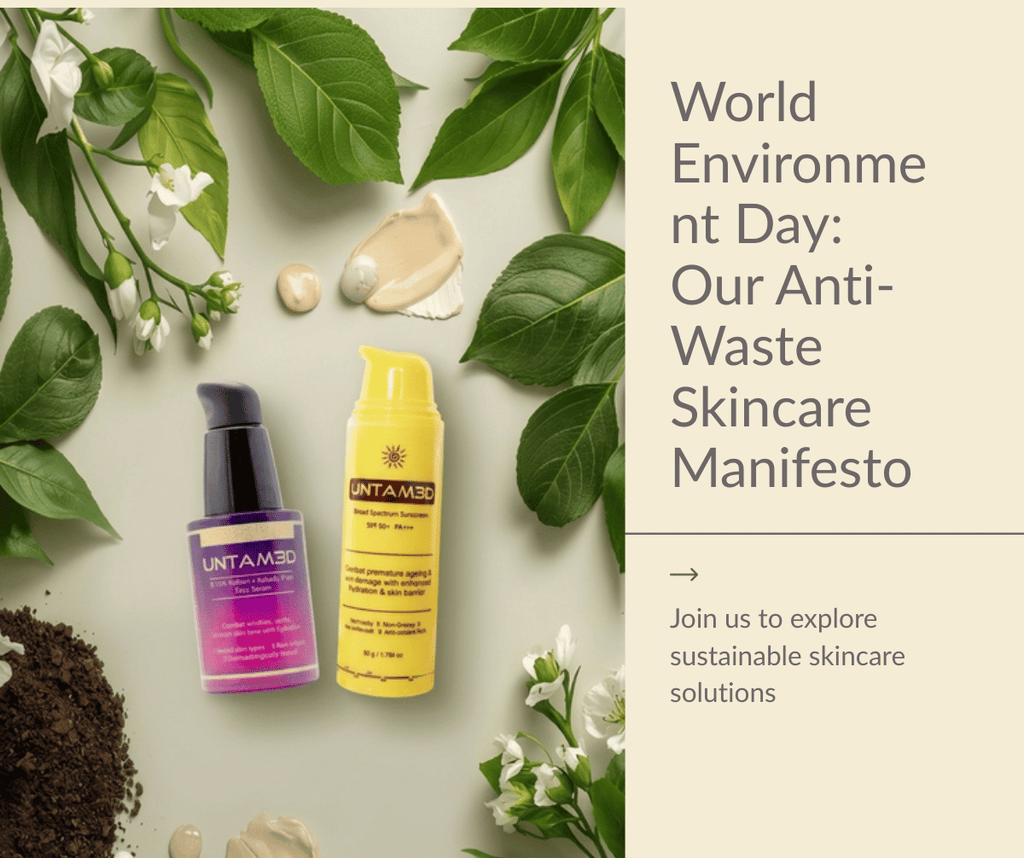
World Environment Day: Our Anti-Waste Skincare Manifesto
Anti-Routine Is Also Anti-Waste: A World Environment Day Manifesto
The skincare industry's most destructive myth is that more products mean better results. This belief drives massive environmental waste: millions of partially-used bottles ending up in landfills, excessive packaging that creates pollution, and the environmental cost of manufacturing products that never actually improve anyone's skin. The anti-routine philosophy isn't just about simplifying your regimen—it's fundamentally anti-waste. By choosing two potent products over ten mediocre ones, you eliminate packaging waste, reduce manufacturing footprint, save money that you're not throwing away on ineffective products, and prove that minimalism in skincare is also environmental responsibility. As we approach World Environment Day, recognizing this connection becomes critical: every product you eliminate from your routine is one less bottle that will become landfill, one less chemical compound entering water systems during manufacturing, and one less carbon footprint from shipping and transportation. True skincare sustainability isn't about greenwashing or vague environmental claims—it's about the radical simplicity of actually using what you buy, choosing products potent enough to deliver results, and understanding that waste reduction and skin health are inseparable.
How The 10-Step Routine Created The Waste Crisis We Face Today
The modern skincare industry convinced consumers that complexity equals effectiveness. The "10-step Korean beauty routine" went viral roughly a decade ago, followed by countless variations: the 12-step routine, the 15-step luxury routine, the "complete skincare system" that promised results only achievable through accumulation. Dermatologically, this was never necessary. Medically sound skincare has always been simple: cleanse, treat with actives, protect with sun protection. Yet the industry built an empire on the belief that more steps meant more benefits, and consumers embraced this idea with enthusiasm.
The environmental consequences have been devastating. The beauty industry generates approximately 120 billion units of packaging annually worldwide—most of it plastic or metal destined for landfills. Skincare products are particularly wasteful: the average person uses only 30% of the product they purchase before moving to the "next big thing." These partially-used bottles represent pure waste: the packaging, the manufacturing carbon footprint, the shipping emissions—all for products that never reached their intended purpose. In India, where recycling infrastructure remains limited, this waste is particularly problematic. Landfills fill with skincare bottles that will persist for centuries, leaching chemicals into soil and water.
Manufacturing footprint compounds the problem. Creating a single skincare product involves extracting raw materials, processing them through energy-intensive facilities, mixing formulations, filling and sealing containers, and shipping globally. A 10-step routine multiplies these environmental costs tenfold. Water usage during manufacturing is particularly egregious: producing one liter of cosmetic product typically requires 10-30 liters of water. When consumers buy 10 products but only use 30% of them, they're wasting not just packaging but also the water, energy, and resources embedded in that product.
Chemical pollution from unused products is equally concerning. When skincare products end up in landfills or are disposed of improperly (flushed down drains), their active ingredients—retinol, acids, preservatives, synthetic fragrances—enter water systems. These chemicals persist in the environment, accumulating in aquatic ecosystems and eventually reaching drinking water supplies. The beauty industry's contribution to water contamination is significant but rarely acknowledged. Ten partially-used bottles mean ten times the chemical pollution compared to one effectively-used product.
Why Minimalist Skincare Is Environmental Activism
Choosing a minimalist skincare routine—or the anti-routine as UNTAM3D terms it—is a form of environmental activism. Every product you don't buy is a bottle that doesn't end up in a landfill, water that wasn't wasted in manufacturing, and carbon emissions that weren't created through production and shipping. This isn't about vague "eco-consciousness" or performative environmentalism; it's about concrete, measurable reduction in environmental harm.
The mathematics are straightforward. Assume an average skincare enthusiast buys 10 products per year to try various formulations. Each product generates approximately 150 grams of packaging waste (plastic bottle, cap, box, insert, tissue paper). That's 1.5 kilograms of packaging waste annually from one person. Across India's roughly 100 million skincare consumers, this represents 150 million kilograms of packaging waste yearly—just from product trials. If even half these people adopted a two-product anti-routine instead, they'd eliminate 75 million kilograms of annual packaging waste.
The manufacturing carbon footprint reduction is equally significant. A typical skincare product's carbon footprint from manufacturing to consumer is approximately 0.5-1.5 kg CO2 equivalent per 50ml product. A 10-product routine creates 5-15 kg CO2 equivalent annually. A two-product routine creates 1-3 kg CO2 equivalent—roughly 5-10 times lower. When millions of people shift to anti-routine skincare, the cumulative emissions reduction becomes comparable to taking significant numbers of cars off the road.
Water conservation through minimalist skincare is particularly significant in India, where water scarcity is increasing. Every product not manufactured is approximately 5-15 liters of water saved. A person adopting anti-routine skincare instead of a 10-step routine saves 50-150 liters of manufacturing water annually. This might seem modest for one person, but scaled across millions of consumers, this represents billions of liters of water conserved—water that remains available for agricultural and drinking purposes rather than being used to manufacture products that end up unused.
The Hidden Environmental Cost of "Natural" and "Eco-Friendly" Marketing
A troubling irony in the skincare industry: products marketed as "natural" and "eco-friendly" often create equal or greater environmental harm than conventional products. This greenwashing creates false environmental permission that drives consumption rather than reduction. A consumer who buys eight "natural" skincare products because they perceive them as environmentally benign is creating just as much waste as someone buying eight conventional products—potentially more, because the "eco-friendly" packaging might be more resource-intensive (like glass bottles that require more energy to produce) while delivering the same partial-use waste.
The "natural" ingredient sourcing often involves intensive land use, water extraction, and habitat disruption. Ingredients like argan oil, which is "natural" and "eco-friendly," have created environmental stress in Morocco where over-harvesting has become problematic. Similarly, "sustainably sourced" botanical ingredients often involve supply chains that are anything but sustainable when examined closely. The environmental impact of sourcing rare botanical ingredients sometimes exceeds the impact of conventional chemical alternatives, yet marketing emphasizes naturalness without substance.
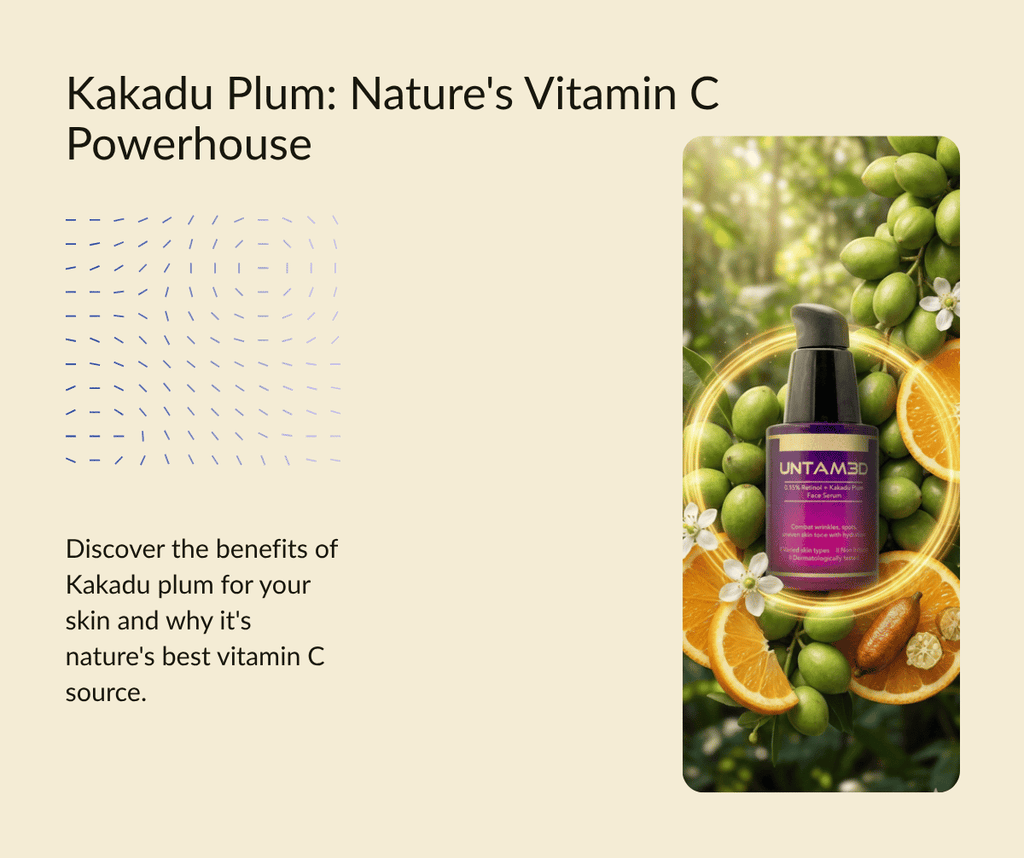
To be clear, this isn't an argument against natural ingredients—many are excellent, including the Kakadu Plum in UNTAM3D's serum. The point is that "natural" as a marketing label doesn't automatically mean environmentally superior. Effective skincare uses the best-performing ingredients regardless of origin, combined with responsible preservative systems that ensure product safety and longevity. This marketing obscures a fundamental truth: the most sustainable skincare product is the one you don't buy. The second-most sustainable product is one you actually use completely. A synthetic, conventionally-manufactured serum that you use to completion has lower environmental impact than a "natural" oil you buy and use 30% of before moving to something new. The anti-routine philosophy cuts through this marketing noise: focus on efficacy and completion rate rather than ingredient narratives. If a product works, you'll use it. If you use it completely, the environmental cost per skincare benefit delivered becomes minimal.
Calculating Your Personal Skincare Waste Footprint
Understanding your personal skincare waste helps contextualize the environmental impact of your choices. Start by counting how many skincare products you purchased in the last year. Don't just count current products—include those you abandoned mid-use, threw away, or gave away because they didn't work for you. Be honest about this count; it's often higher than people initially realize.
Next, estimate the percentage of each product you used before moving to something new. Did you finish the bottle? Use 75%? 50%? 25%? This percentage directly correlates to waste. If you purchased 10 products and used only 30% of each (a realistic estimate for most skincare consumers trying different products), you effectively wasted 70% of your skincare purchases. In terms of waste, you created 7 products' worth of waste for 3 products' worth of benefit.
Now calculate the environmental impact. Each 50ml product generates approximately 1kg CO2 in manufacturing and shipping. If you purchased 10 50ml products (total 500ml, or 0.5 liters), your annual skincare consumption created approximately 10kg of CO2 emissions. The packaging waste—10 bottles, caps, boxes, inserts—represents approximately 1.5kg of material destined for landfills. The water used in manufacturing approximately 10 products is roughly 100-150 liters.
Now compare this to the anti-routine: purchasing 2 products per year (still allowing for one replacement cycle), using each completely. You create 2kg CO2 emissions, 0.3kg of packaging waste, and use 20-30 liters of manufacturing water. You've reduced your skincare environmental footprint by 80% simply by choosing fewer, more effective products. This calculation isn't abstract—it represents a concrete reduction in your environmental impact that occurs immediately and annually.
The Economic Justice of Anti-Waste Skincare
Environmental sustainability intersects with economic justice in skincare. The skincare industry disproportionately targets middle and upper-income consumers in India, convincing them that expensive product collections are necessary. Meanwhile, this industry's waste—manufacturing chemicals, plastic pollution, water contamination—disproportionately impacts lower-income communities living near manufacturing facilities and downstream of disposal sites. Environmental degradation from skincare production often affects those least able to afford skincare products, creating an inequitable system where wealthier consumers outsource their environmental harm to poorer communities.
The anti-waste approach addresses this injustice by reducing total environmental harm that affects everyone. When fewer products are manufactured, fewer communities experience pollution from manufacturing. When less packaging waste is generated, fewer landfills are created in lower-income areas. When less water is used in manufacturing, more water remains available for agricultural and drinking purposes in water-scarce regions. Environmental sustainability and economic justice are inseparable, and choosing minimalist skincare contributes to both.
Additionally, the anti-routine approach makes quality skincare economically accessible. Rather than spending 3000-5000 rupees monthly on 10 partial products, the anti-routine allows people to invest 2000 rupees in two excellent products that actually deliver results. This shifts skincare economics: instead of accumulation determining efficacy, quality and actual use determine results. For many people, this makes proven skincare accessible rather than aspirational.
UNTAM3D's Environmental Commitment Beyond Products
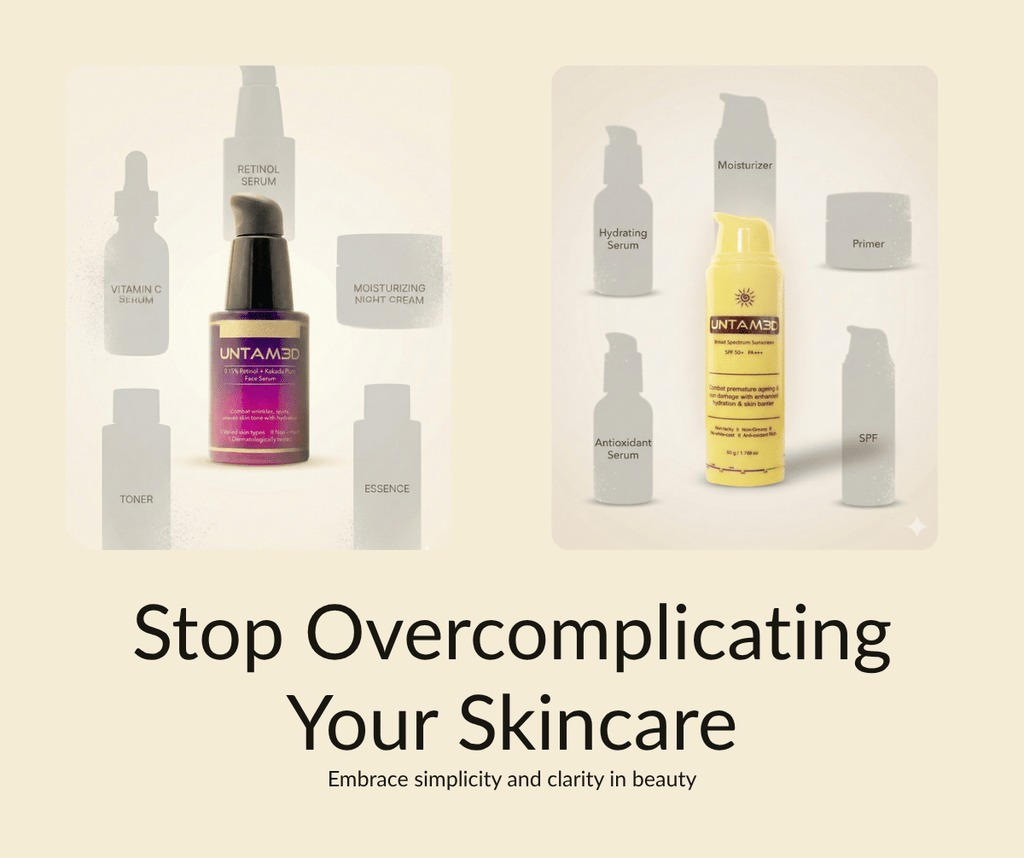
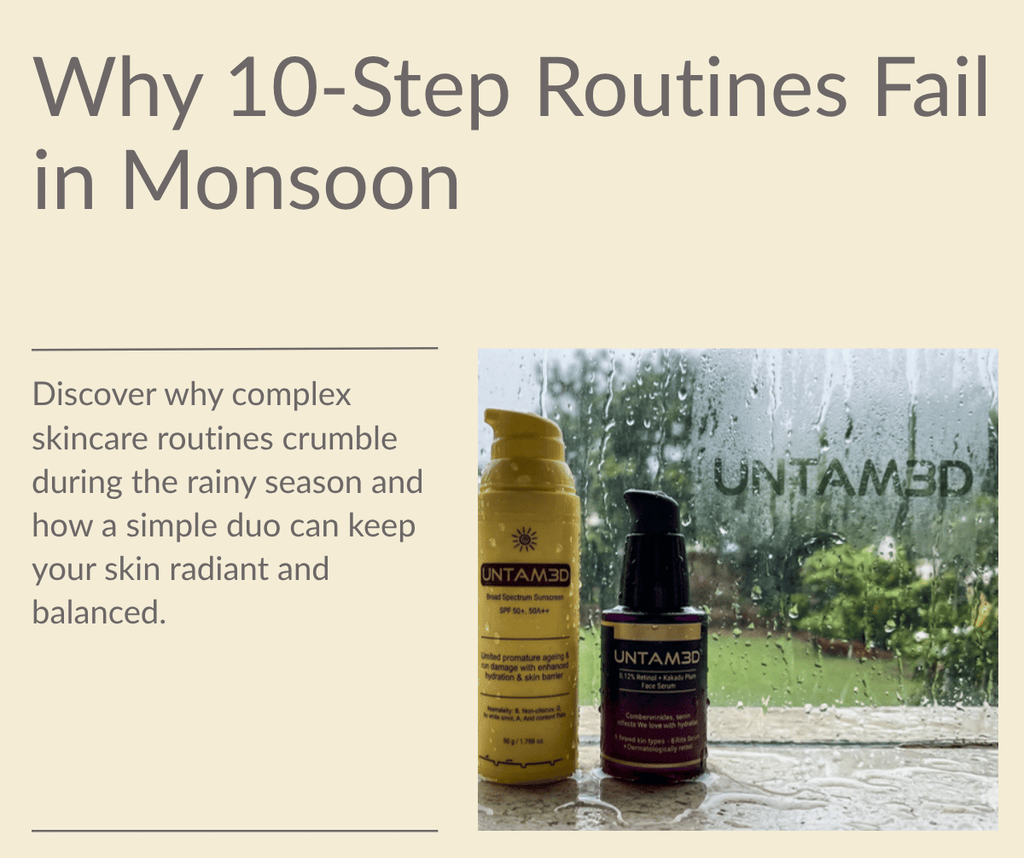
UNTAM3D's anti-routine philosophy is fundamentally anti-waste. The brand was built on the recognition that skincare sustainability means reducing consumption, not just greenwashing existing consumption. By creating two potent products—the Retinol + Kakadu Plum Face Serum and Broad Spectrum Sunscreen SPF 50+ PA+++—that actually replace 10-15 product routines, UNTAM3D eliminates waste at the source. You're not buying 10 products hoping 3 work; you're buying 2 products engineered to work completely. The sunscreen's ceramides and phospholipids eliminate the need for separate barrier repair products. The serum's combination of retinol, Kakadu Plum vitamin C, and EGCG eliminates the need for separate treatments. This isn't marketing simplification; it's engineering efficiency. When UNTAM3D encourages customers to replace 10-step routines with 2-step routines, the environmental impact is immediate: 80% less packaging, 80% less manufacturing footprint, 80% less chemical pollution risk. As a climate-aware brand, UNTAM3D recognizes that environmental responsibility isn't achieved through eco-packaging or natural ingredient claims—it's achieved through fundamentally reducing the products people buy and use. Every customer who adopts the anti-routine reduces their skincare environmental footprint by 80%, which scales across millions of people into genuinely significant environmental protection.
World Environment Day 2026: What Your Skincare Choices Actually Mean
World Environment Day, celebrated on June 5th, emphasizes humanity's responsibility to restore and protect our environment. In the context of skincare, this responsibility is concrete and personal: every product you add to your routine increases environmental harm, while every product you eliminate reduces it. This isn't abstract environmental activism requiring government policy changes or waiting for industrial transformation. It's immediate, measurable change you can implement today.
The theme of environmental restoration suggests moving beyond "sustainable consumption" (which paradoxically encourages buying products marketed as sustainable) toward genuine waste reduction. True restoration requires less consumption overall, not clever marketing about sustainable consumption. In skincare, this means questioning whether each product in your routine truly serves a necessary function. Can a serum and moisturizer replace your 10-step routine? For most people: absolutely yes. The research supports this—studies on skincare efficacy show that consistency with 2-3 quality products outperforms inconsistent use of 10-15 products.
This World Environment Day, your skincare choice is environmental activism. Choosing a 2-step anti-routine over a 10-step routine reduces your environmental footprint by 80%. Choosing to actually use your products completely rather than abandoning them halfway prevents waste. Choosing products based on actual efficacy rather than marketing prevents economic waste and environmental waste simultaneously. These choices, multiplied across millions of skincare consumers, represent significant environmental impact—comparable to individual actions like reducing transport emissions or eliminating food waste.
The environmental impact of your skincare routine is not theoretical or distant—it's immediate and measurable. Each bottle you don't buy is plastic that doesn't end up in a landfill. Each product you use completely is water and carbon that served an actual purpose. Each routine you simplify is environmental harm reduced. As you approach World Environment Day, recognize that environmental responsibility often means less, not more. The anti-routine isn't a skincare trend; it's an environmental imperative.
Frequently Asked Questions
Is buying "eco-friendly" skincare enough to reduce environmental impact?
Eco-friendly packaging and natural ingredients make a product feel more sustainable, but they don't address the fundamental environmental problem: overproduction and waste. A "natural" skincare product you use 30% of creates nearly the same environmental harm as a conventional product used 30% of. The environmental benefit is minimal compared to simply reducing the number of products you buy. The most sustainable skincare product is the one you don't purchase. The second-most sustainable is one you actually use completely. Focusing on "eco-friendly" marketing while continuing to buy excessive products is environmental theater rather than actual environmental protection. True sustainability comes from reduction first, then choosing quality products for the items you do buy.
How do I know if my skincare routine is creating unnecessary waste?
Count the products you've purchased but never finished. These represent pure waste: packaging, manufacturing, shipping, and environmental cost with zero benefit. If you've purchased more than 3-4 skincare products in the last year and haven't finished them all, you're likely creating unnecessary waste. Additionally, if your routine contains multiple products addressing the same concern (two different moisturizers, multiple serums, several toners), consolidation would eliminate waste while improving consistency. The anti-routine principle applies: can two potent products replace your current five or ten? If yes, the eliminated products represent only waste, not benefit. Most people find they can streamline to two products without sacrificing results.
Does choosing generic or inexpensive skincare reduce environmental impact?
Price and environmental impact don't correlate directly. A cheap product you don't finish creates waste equivalent to an expensive product you don't finish. However, cheaper products are often purchased more frequently due to lower perceived risk, which can increase total consumption and waste. The environmental impact depends entirely on completion rate. A higher-quality product you actually use completely has lower environmental impact per skincare benefit than a cheaper product you use partially. Additionally, products that deliver results (regardless of price) are used consistently, reducing the impulse to try alternatives. This is why investing in two quality products often reduces environmental impact compared to buying many inexpensive products seeking efficacy.
What about skincare waste from people with sensitive skin who need to find the right product?
People with sensitive skin genuinely need to trial products more extensively, which creates legitimate waste. However, this doesn't justify the 10-step routine concept for most people. For sensitive skin, a minimalist approach becomes even more valuable: try one serum until you determine if it works (2-3 weeks), then commit to it; try one moisturizer thoroughly before moving to another. This methodical, minimal approach reduces waste compared to trying 10 different serums and 10 different moisturizers. Additionally, support communities and patch-testing help sensitive-skin consumers make better choices without excessive trialing. For sensitive skin, the anti-routine approach is more important, not less important—fewer products mean fewer potential irritants, and committed focus on each product allows for proper evaluation rather than assumption that the next product will be better.
Can I recycle my old skincare bottles to reduce environmental impact?
Recycling helps, but it's the last resort in the hierarchy of environmental responsibility: reduce first, then reuse, then recycle. Recycling uses energy and resources, though less than manufacturing new packaging. However, most plastic skincare bottles don't get recycled—they end up in landfills despite being technically recyclable, often because they're contaminated with residual product or because collection infrastructure doesn't capture them. Even when successfully recycled, the process uses significant energy. The most effective approach is reducing the number of bottles you create in the first place. Committing to fewer products eliminates this problem entirely: fewer bottles created means less waste regardless of whether recycling succeeds or fails. Recycling existing bottles is positive, but preventing their creation in the first place is profoundly more impactful.
Sources and Further Reading
- Ellen MacArthur Foundation: "The Circular Economy in the Beauty Industry"
- Mintel: "Sustainability in the Global Beauty Market" (2024 analysis)
- United Nations Environment Programme: "World Environment Day and Plastic Pollution"
- Journal of Cleaner Production: "Life Cycle Assessment of Skincare Product Manufacturing"
- Water Footprint Network: "Water Usage in Cosmetic Manufacturing"
- Global Federation of Competitiveness Councils: "Environmental Impact of the Beauty Industry Supply Chain"
Join the anti-waste skincare movement this World Environment Day.
Choose Anti-Routine. Choose Anti-Waste.RECENT POSTS