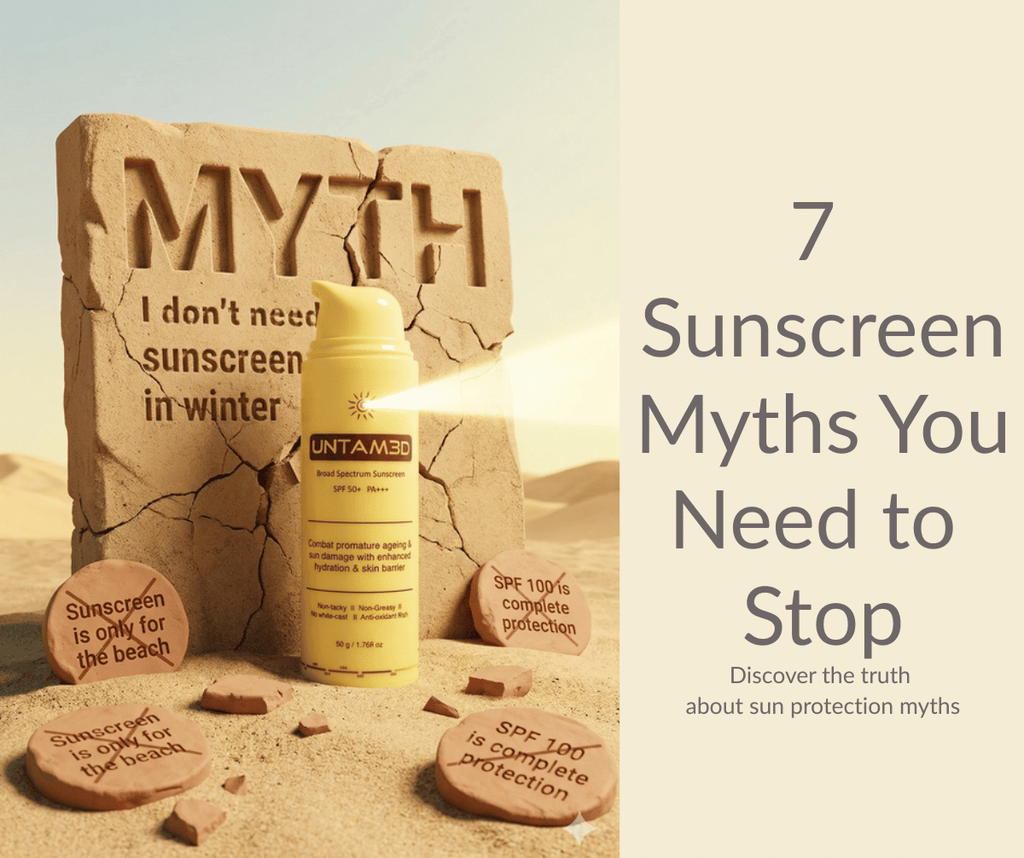
7 Sunscreen Myths You Need to Stop Believing Right Now
Sunscreen Myths Indian Women Still Believe (Debunked by Science)
The truth: Indian women navigate intense UV radiation daily, yet misinformation about sunscreen pervades skincare conversations across urban centers. From "sunscreen causes dark spots" to "you don't need it indoors," these myths prevent millions from protecting their skin against photoaging, hyperpigmentation, and skin cancer. Science shows that daily broad-spectrum SPF 50+ PA+++ sunscreen is non-negotiable for Indian skin, regardless of skin tone or weather. This isn't about vanity—it's about preventing cumulative sun damage that compounds over decades. When you understand what sunscreen actually does versus what myths claim it does, you can make informed decisions that align with your skin's real needs.
India receives 300+ sunny days annually, and UV index levels regularly spike above 11 during summer months. Yet the skincare aisle remains crowded with myths that discourage sun protection. We're breaking down eight persistent misconceptions that have shaped—and harmed—Indian skincare practices, replacing them with evidence-based guidance you can trust.
Does Sunscreen Actually Cause Dark Spots and Hyperpigmentation?
This is perhaps the most damaging myth circulating among Indian women. The belief that sunscreen causes dark spots has convinced millions to skip daily protection, ironically accelerating the very problem they fear. The reality is the opposite: unprotected sun exposure is the primary trigger for melasma, post-inflammatory hyperpigmentation, and uneven skin tone—conditions extraordinarily common in Indian skin.
What likely created this myth? Early sunscreen formulations were heavy, occlusive, and contained fragrance and oils that could clog pores and trigger inflammation in humid climates. That inflammation, when exposed to UV rays, can worsen existing hyperpigmentation. Modern broad-spectrum sunscreens, formulated with lightweight ceramides and phospholipids, don't trap bacteria or heat. They sit on the skin's surface, allowing it to breathe while blocking UV damage—the very thing causing dark spots in the first place.
The dermatological consensus is clear: consistent sunscreen use prevents and lightens existing hyperpigmentation. The misconception persists because people who switch to daily sunscreen eventually see fading of old sun damage as melanin production normalizes—but they attribute that fading to the sunscreen "purging" pigment, rather than understanding it as healing from finally being protected.
Is SPF 30 Really Enough, or Do You Need SPF 50+?
The jump from SPF 30 to SPF 50+ seems mathematically insignificant—after all, it's only a 20-point difference. But sunscreen mathematics doesn't work linearly. SPF 30 filters approximately 97% of UVB rays, while SPF 50+ filters 98-99%. That remaining 1-2% matters exponentially when you're in India's intense tropical climate with UV index levels that regularly exceed international standards.
Consider your application habits too. Studies show the average person applies far less sunscreen than the amount used in SPF testing (2mg per square centimeter). When you apply sunscreen in real-world conditions—a bit less than recommended—SPF 30 may perform closer to SPF 15. Using SPF 50+ PA+++ creates a buffer that accounts for imperfect application while still delivering meaningful protection against both aging UVB rays and skin-darkening UVA rays.
PA+++ is equally important as the SPF number. In India's context where melasma and uneven pigmentation are concerns, the PA rating (which measures UVA protection) is often more relevant than the SPF number alone. UVA rays penetrate deeper, cause collagen breakdown, and trigger melanin production—the mechanisms behind photoaging and dark spots. SPF 50+ PA+++ is the scientifically optimal baseline for Indian skin.
Do You Really Need Sunscreen Indoors and on Cloudy Days?
This myth has probably cost Indian women years of cumulative sun damage. The short answer: yes, you need it both indoors and on cloudy days, though the level of protection differs by location. UVA rays penetrate glass windows and clouds—they're not blocked by either. UVB rays (the primary cause of sunburns) are partially blocked by clouds and glass, but UVA rays largely pass through unchanged.
For someone working in an air-conditioned office with windows facing south or west, daily UV exposure is real and significant. Studies measuring UV exposure in Indian offices have documented meaningful UVA penetration, especially in morning and afternoon hours. Over 40 years of working life, this unprotected indoor exposure contributes substantially to photoaging, fine lines, and melasma development.
On cloudy days, UV index can remain at 5-7 in India even when the sky appears overcast. Clouds scatter and diffuse UV rays rather than blocking them entirely. A cloudy beach day with no sunscreen often results in sunburn because the water reflects UV rays upward, intensifying exposure. Dermatologists across India recommend daily sunscreen application regardless of weather or location, as a baseline non-negotiable step in any climate-conscious skincare routine.
Will Sunscreen Leave Your Skin Greasy or Cause Breakouts?
This concern is valid for certain formulations, but it's become weaponized as a general indictment against all sunscreens. The problem typically lies in sunscreen type, not sunscreen in general. Chemical sunscreens (which absorb UV rays and convert them to heat) often feel lighter but can trigger photosensitive reactions or irritation in sensitive skin. Physical sunscreens (mineral-based) provide broader protection but can feel heavy or leave a white cast if formulated poorly.
Modern broad-spectrum sunscreens specifically formulated for humid tropical climates use hybrid formulations combining physical and chemical filters, enhanced with ceramides and phospholipids that regulate skin barrier health rather than disrupting it. These lightweight formulations sit on the skin without clogging pores, allow natural sebum production, and won't trigger breakouts in acne-prone skin. The key is choosing a sunscreen designed for your climate and skin type, not abandoning sun protection entirely.
Many dermatologists in India now recommend oil-free, non-comedogenic sunscreens specifically formulated for humid conditions. The breakouts people experienced with older sunscreens were often due to occlusive ingredients and heavy textures—problems that modern formulation science has largely resolved. Blaming sunscreen rather than reformulating your approach means sacrificing skin health to avoid temporary texture issues.
Can You Skip Sunscreen if You Have Dark Skin?
This myth is particularly harmful and deeply rooted in colorist thinking that associates sun protection with lighter skin tones. The scientific reality is unambiguous: darker skin tones have higher baseline melanin, which provides some natural UV protection—estimated at roughly SPF 3-4 equivalent in darker Fitzpatrick types. But "some protection" is not "enough protection." Even people with naturally dark skin develop melasma, photoaging, and skin cancer.
Melasma is extraordinarily common in Indian women across all skin tones, triggered by sun exposure, hormonal shifts, and genetic predisposition. Photoaging manifests differently in darker skin—less obvious wrinkling initially, but accelerated collagen breakdown, loss of elasticity, and uneven skin tone become apparent over decades. Skin cancer absolutely occurs in darker skin tones, often diagnosed at later stages because of the false belief that dark skin doesn't need protection.
The narrative that sun protection is unnecessary for dark skin is not only scientifically false but perpetuates health disparities. Every person, regardless of skin tone, benefits from daily broad-spectrum SPF 50+ PA+++ protection. Dermatological organizations across the world, including India's Association of Dermatologists, emphasize that sun protection is universal and non-negotiable regardless of melanin levels.
Is Higher SPF Worth the Cost, or Is It Just Marketing?
The increase from SPF 30 to SPF 50+ does represent genuine additional protection, even if the percentage difference seems small numerically. However, the cost difference between a decent SPF 30 and SPF 50+ sunscreen shouldn't be dramatic. If brands are charging 3-4x more for SPF 50+ than SPF 30, that's inflation driven by packaging and positioning, not by the actual cost of protective ingredients.
A quality broad-spectrum SPF 50+ PA+++ sunscreen formulated for Indian skin should cost between ₹800-₹1,200 for a 50ml bottle—roughly equivalent to premium sunscreens globally. The return on investment is substantial: preventing one case of severe melasma or photoaging costs far more in treatments than investing in daily sunscreen ever will. Dermatologists consistently recommend that sunscreen investment should never be compromised—it's the most cost-effective anti-aging step available.
That said, not all expensive sunscreens are better. Marketing claims, celebrity endorsements, and premium packaging don't correlate with protection quality. A ₹999 sunscreen with clearly listed SPF 50+ PA+++ and ceramides plus phospholipids offers identical protection to a ₹3,000 version that includes influencer collaboration. The key metrics are the SPF number, PA rating, formulation type, and active ingredients—not the brand prestige or price tag.
Does Sunscreen Interfere with Vitamin D Synthesis?
This myth has gained traction among wellness communities, creating unnecessary anxiety about sun protection. The concern is that sunscreen blocks UV rays entirely, preventing the skin from producing Vitamin D. While the premise contains a kernel of truth, the practical implications are vastly overstated in Indian contexts.
Yes, sunscreen reduces UVB radiation exposure, which is necessary for Vitamin D synthesis. But India receives such intense and prolonged sunlight that even with consistent sunscreen use, most people maintain adequate Vitamin D levels through incidental sun exposure—time spent outdoors without sunscreen on hands, face during early morning or late evening hours, and dietary sources. Studies of people in tropical regions who consistently use sunscreen show normal to elevated Vitamin D levels.
Additionally, Vitamin D synthesis is most efficient during midday hours when UV index is also highest—exactly when sun protection is most critical. Early morning and late evening sun, when UV intensity is lower and Vitamin D synthesis less efficient, pose minimal burning risk. A balanced approach means consistent SPF 50+ PA+++ sunscreen during peak sun hours (10am-4pm) while maintaining incidental outdoor exposure and including Vitamin D-rich foods in your diet.
Will Reapplying Sunscreen During the Day Cause Buildup?
The guidance to reapply sunscreen every two hours creates anxiety about product accumulation on skin, leading many people to skip reapplication entirely. In reality, sunscreen doesn't "build up" on healthy skin the way other products might. Modern sunscreen formulations are designed to sit on the stratum corneum (the outermost skin layer) and gradually wear away through friction, sweating, and natural skin cell turnover.
When you reapply sunscreen, you're not adding layer upon layer of impenetrable barrier. You're replacing sunscreen that's worn away due to environmental exposure and normal skin activity. The concern about buildup typically arises with very heavy, occlusive sunscreens—again, a formulation problem, not a sunscreen problem. Lightweight, well-formulated broad-spectrum sunscreens designed for humid tropical climates reapply cleanly without visible residue or texture changes.
For optimal protection in India's climate, dermatologists recommend reapplication every 2-3 hours if you're outdoors, immediately after swimming or heavy sweating, and at minimum once during the workday if you spend time near windows. This isn't excessive—it's the only way to maintain meaningful protection given India's UV intensity. Using a properly formulated sunscreen eliminates buildup concerns entirely.
How UNTAM3D Approaches Sun Protection
UNTAM3D's Broad Spectrum Sunscreen SPF 50+ PA+++ is engineered for the realities of Indian skin and Indian climate. Rather than relying on heavy mineral bases that leave white cast, or fragile chemical filters that break down under intense UV exposure, UNTAM3D combines broad-spectrum protection with ceramides and phospholipids that support skin barrier health instead of disrupting it.
The formulation includes blue light protection—essential for Indian women who spend significant time both outdoors and in front of screens. Non-greasy and formulated for humid conditions, it's designed for daily use without triggering the texture complaints that have discouraged millions from consistent sun protection. At ₹999, it's positioned as an investment in skin health, not a luxury purchase.
UNTAM3D's philosophy rejects the myth that sun protection requires complex multi-step routines. A single, effective broad-spectrum SPF 50+ PA+++ sunscreen can replace the multiple unreliable products that create false security without delivering real results. Climate-aware formulation means engineering sunscreen that works with India's humidity, heat, and UV intensity rather than against it.
Shop Broad Spectrum Sunscreen SPF 50+ PA+++Frequently Asked Questions About Sunscreen Myths
Does sunscreen cause acne or clogged pores in humid Indian weather?
Not if you're using a properly formulated sunscreen. The issue is typically with formulations designed for dry climates that don't account for India's humidity. Modern sunscreens specifically formulated for tropical conditions use lightweight emulsions with ceramides that allow skin to breathe. If you experience breakouts, it's usually a formulation mismatch, not sunscreen itself being problematic.
How much sunscreen should you actually apply for SPF 50+ protection?
The dermatological standard is approximately 1/4 teaspoon for face and neck combined, or about 2mg per square centimeter. Most people apply significantly less, which is why higher SPF numbers (50+ rather than 30) provide important buffer against real-world application habits. For daily use, apply enough that it spreads easily without dragging or tugging the skin.
Can you use last year's sunscreen, or does SPF degrade over time?
Sunscreen ingredients can degrade with age, heat exposure, and light exposure, making protection less reliable. In India's hot climate, sunscreen exposed to heat loses efficacy faster than in temperate regions. It's recommended to use sunscreen within one year of opening and avoid storing it in hot cars or direct sunlight. When in doubt, replace it rather than rely on potentially degraded protection.
Is "natural" or "chemical-free" sunscreen actually safer than broad-spectrum options?
This is another damaging myth. So-called "natural" sunscreens often lack adequate UV filtering and may contain ingredients that irritate sensitive skin. Broad-spectrum sunscreens using both physical and chemical filters, when properly formulated, are extensively tested and proven safe for daily use. The term "chemical" is scientifically misleading—all sunscreens use chemistry. Effectiveness and safety depend on formulation and testing, not marketing language.
Should sunscreen be applied before or after other skincare products?
Sunscreen should be the final step in your skincare routine, applied after any serums, moisturizers, or treatments. This allows active ingredients to absorb fully while ensuring the sunscreen sits on the skin surface where it can form an effective protective layer. Apply it on completely dry skin for best results, waiting 2-3 minutes after other products before going outdoors.
The Evidence is Clear: Daily Sunscreen is Non-Negotiable
After decades of dermatological research and millions of case studies across Indian populations, the evidence is conclusive: daily broad-spectrum SPF 50+ PA+++ sunscreen prevents photoaging, hyperpigmentation, melasma, and skin cancer. Every myth discouraging sun protection has been scientifically debunked. The persistence of these myths isn't evidence of truth—it's evidence of how deeply misinformation becomes embedded in cultural skincare narratives.
For Indian women facing 300+ sunny days annually and UV index levels that regularly exceed international standards, sunscreen isn't optional. It's the single most impactful anti-aging investment available. The cost of sunscreen is negligible compared to treating advanced photoaging, melasma, or skin cancer. The time investment is minimal—30 seconds of daily application. The excuses that persist—about dark spots, breakouts, cost, or Vitamin D—collapse under scientific scrutiny.
Shifting from myths to evidence-based sun protection means acknowledging that your skin deserves the same protection approach used by dermatologists globally. It means choosing formulations engineered for your climate rather than adapting formulations designed for temperate regions. And it means understanding that climate-aware sun protection, applied consistently, is the foundation upon which all other skincare efforts build.
Sources and Further Reading
- Indian Journal of Dermatology: UV Radiation and Photoaging in South Asian Skin
- Journal of the American Academy of Dermatology: Sunscreen Use and Prevention of Melasma
- Photodermatology, Photoimmunology & Photomedicine: UVA Penetration Through Windows
- International Journal of Dermatology: Broad-Spectrum Protection and Skin Barrier Health
- WHO Guidelines on Sun Protection and Melanin Levels
- Association of Dermatologists of India: Annual Recommendations on Sun Protection
RECENT POSTS